Case study · Accessibility design · AI · Constraint-driven UX

Building accessible AI for users with real constraints.

Building Farmer.Chat an AI advisory platform for smallholder farmers with first-time smartphone access, low digital literacy, and no shared language with the team designing it.

Role
UX Designer + UX Researcher
Organization
Digital Green
Product
Farmer.Chat · Vistaar · E-farm
Reach
1,00,000+ farmers · India & East Africa
Languages
5+ · WCAG-aligned
Year
2023 to 2025
TL;DR

When your users can't read the product, can't type, and have never seen a chatbot, how do you design AI? That was the constraint. Farmer.Chat was built for smallholder farmers with low digital literacy, no shared language with the design team, and voice as the only reliable input. I led mixed methods research with 1,00,000+ farmers across India and East Africa, and the principle that emerged was simple: design for constraint, not around it. Voice first, not text-first. Crop identity, not user-identity. Research driven, not assumed. Platform engagement rose 25%, content recall rose 28%, and onboarding for the adjacent Vistaar pilot dropped by two days for 20,000+ users. The principle applies wherever users face real barriers to access.

→ Full visual case study on Behance

Abstract illustration: a voice waveform radiating outward to a farmer tending a young plant
Designing for constraint: when a user can't read, can't type, and has never seen a chatbot, voice stops being a feature and becomes the product.
01 · The problem

The user couldn't read the product.

Digital Green's mission is to put high quality agricultural advisory in the hands of smallholder farmers the people growing the world's food on plots smaller than a tennis court. Generative AI made expert advisory cheap to produce. The hard problem was distribution.

Our users:

  • Spoke five primary languages and several regional dialects
  • Were largely non literate or low-literate in any language
  • Were often using a smartphone for the first time in their lives
  • Shared one device across an entire household
  • Came online for short, low data sessions, often on 2G or patchy 4G
  • Trusted other farmers more than they trusted the internet

Almost every assumption we had built our previous tools on was wrong for this user. Chat-as-interface assumes reading. Typing assumes input modality. Even the concept of a chatbot  an entity that listens and responds is not a given when you've never seen one before.

The job was not to localize a chat product. The job was to redesign the assumption.

Localization is translating what you've already built. The work was different: redesigning what to build in the first place, from inside the user's world.
02 · Research

Two years of listening before designing.

I led mixed-methods research across India and East Africa with over 1,00,000 farmers through moderated interviews, in-home contextual inquiry, prototype testing in five languages, and longitudinal usage analysis of the deployed product.

Three insights changed the product.

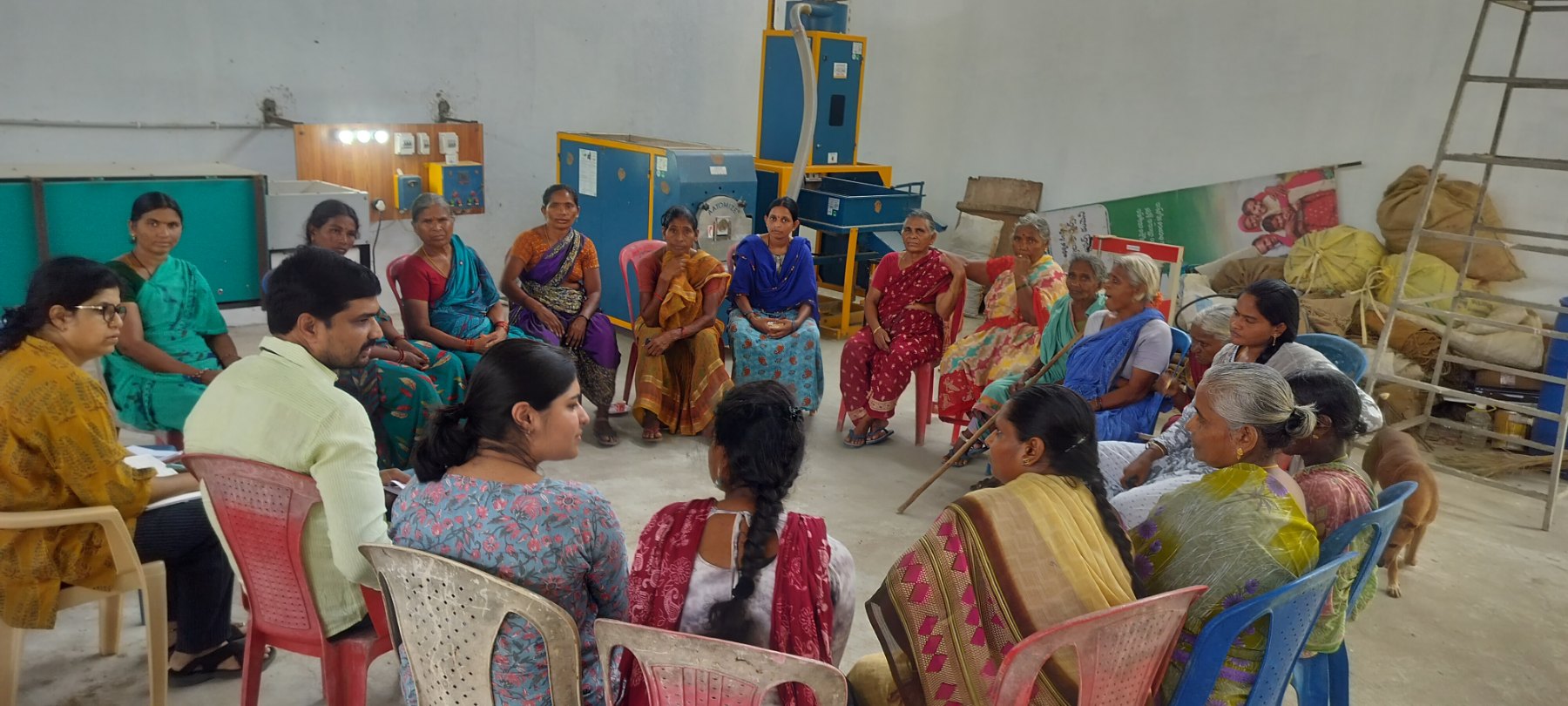
Field research session — a focus-group discussion with smallholder farmers seated in a circle
Field research in practice: a focus-group session with smallholder farmers, the actual users of Farmer.Chat. Two years of this, moderated interviews, contextual inquiry, and prototype testing in five languages, is what turned assumptions into the three insights that reshaped the product.
01
Insight

Voice was not a feature. Voice was the product.

The team's default mental model was chat with voice as an accessibility option. Field research showed the inversion: text was the accessibility option, and only for the small subset of users who could write. Every onboarding flow, every error state, every empty state had to be redesigned voice-first.

02
Insight

Identity belongs to the crop, not the user.

We assumed user profiles would be person-centric: name, region, language. Field research surfaced something different: farmers identified themselves first by what they grew. "I am a wheat farmer." "I am a goat farmer." Personalization built on crop-as-identity outperformed personalization built on demographics, because it matched how users already navigated their own lives.

03
Insight

Trust is transferred, not earned.

Adoption did not happen through good UX. It happened through other farmers: agricultural extension workers, community influencers, and local lead farmers. The product had to be designed for the demonstrator, not only the end user. The most important UX surface turned out to be the one a community worker used to walk a new farmer through their first session.

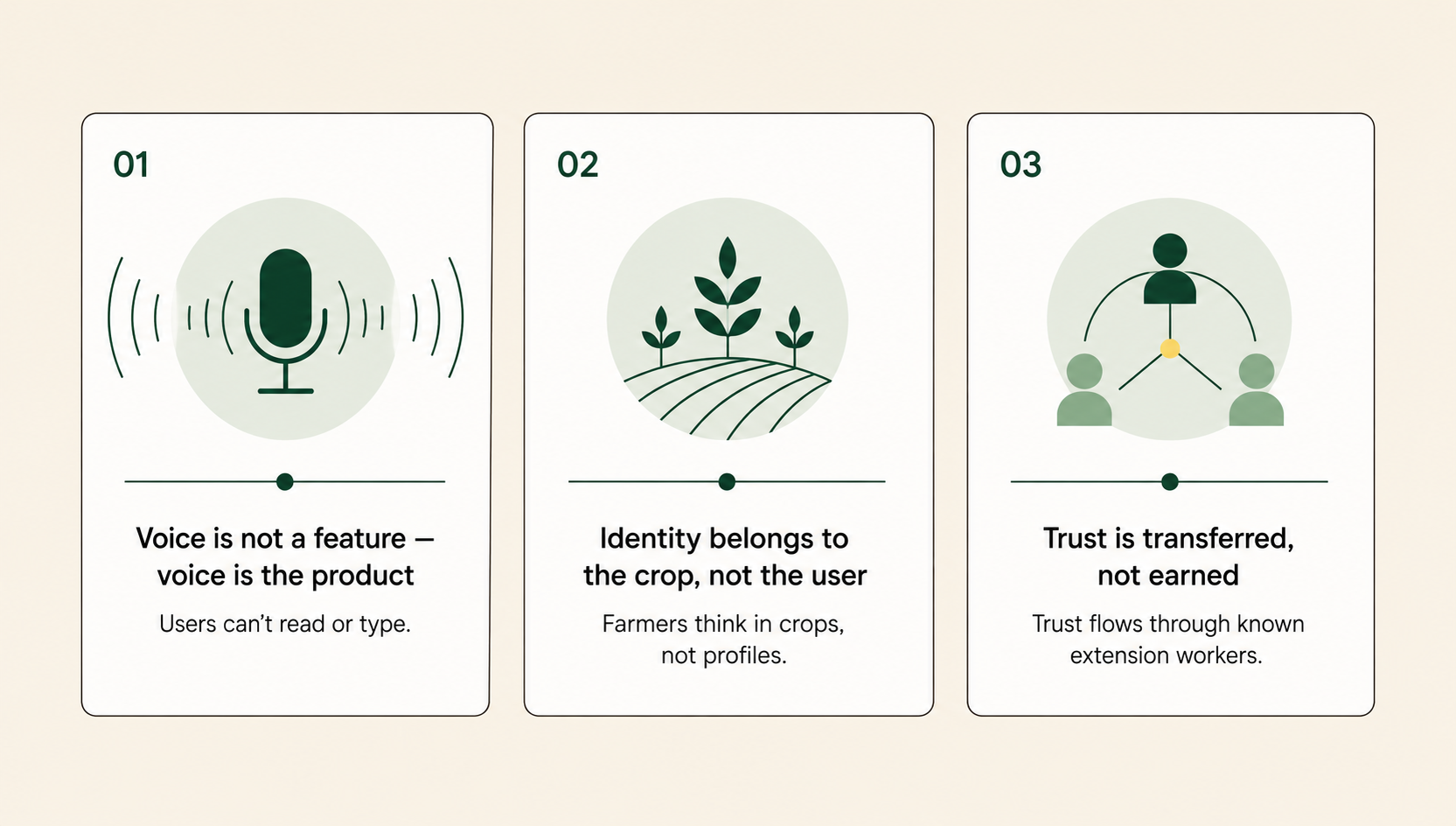
Three research-insight cards: voice is the product, identity belongs to the crop, trust is transferred through extension workers
Three insights from two years of field research that reshaped the entire product: voice as product, crop-first identity, and trust that transfers through known extension workers.
03 · Key decisions

What I chose, and what I gave up.

Five design decisions carried the rest of the product.

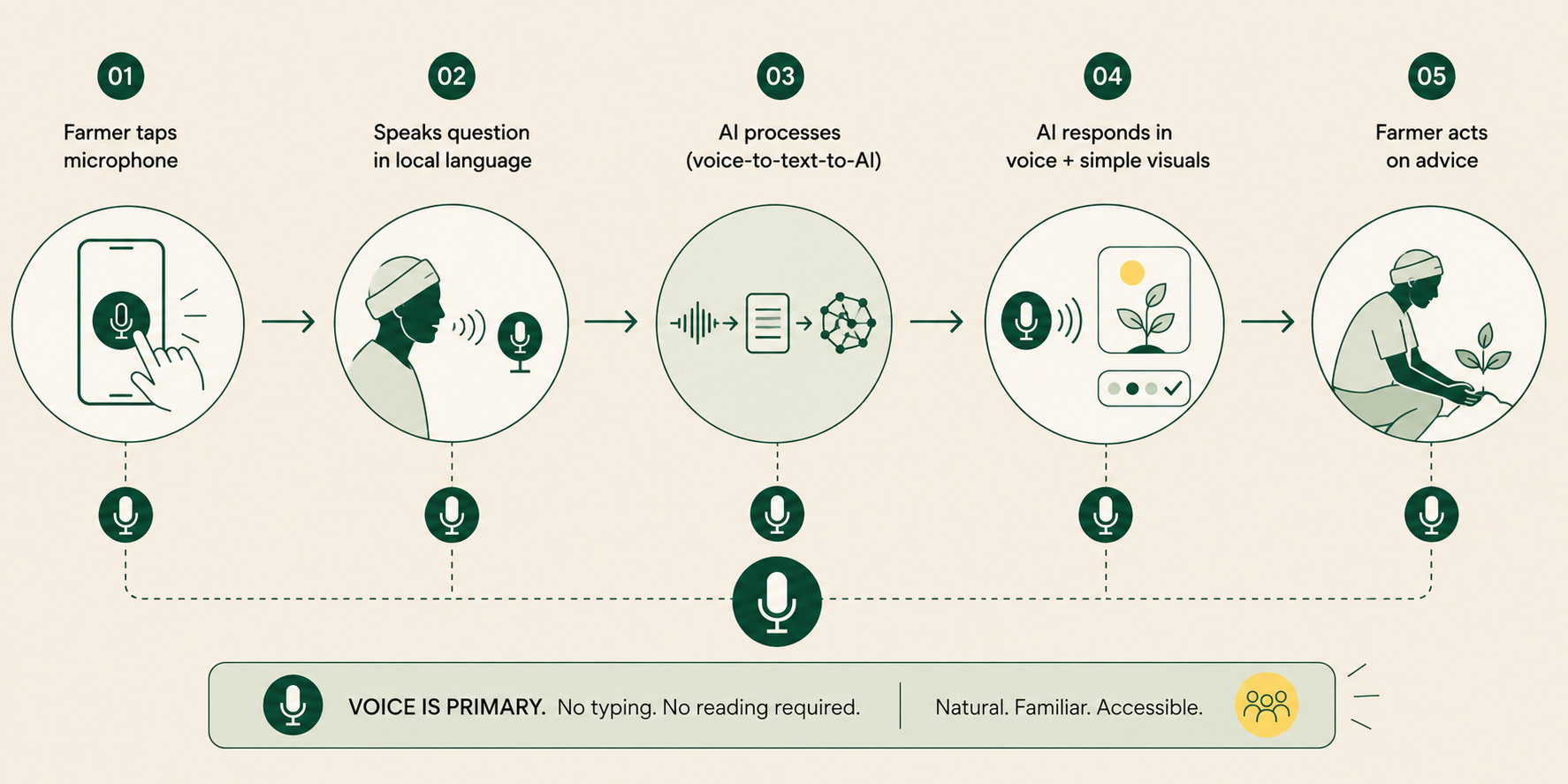
Five-step voice-first interaction loop: tap microphone, speak in local language, AI processes, AI responds in voice and simple visuals, farmer acts on advice
The voice-first interaction loop: tap, speak, process, respond, act. No typing, no reading required. Voice was the primary mode, not an accessibility add-on.
04 · What I shipped

Three products in a connected system.

Farmer.Chat

The AI advisory product. Multilingual, voice-first, deployed across India and East Africa. End-to-end UX: onboarding, conversation surface, voice response design, content cards, error and empty states, offline behaviour.

Vistaar: chatbot flows for a real-time advisory pilot

Prototyped and tested with extension workers and lead farmers. Onboarding time cut by two days for 20,000+ users; real-time progress tracking introduced.

E-farm: AI-persona content tools

AI-personas to make region-specific agricultural content more memorable. Reached 1,00,000+ farmers. Knowledge recall (measured via post-session feedback surveys) rose 28%.

05 · Impact

The numbers that mattered.

+25%
Platform engagement, post-revamp
+35%
Repeat engagement, content design
+28%
Knowledge recall (feedback-measured)
−2 days
Vistaar onboarding time
5+
Languages supported
1,00,000+
Farmers reached, two continents
06 · What I'd do differently

The honest version.

More baseline measurement. Some of the most powerful product changes had only after-state metrics, not before. Next time I'd insist on a two-week instrumented baseline before any design ships, even at the cost of slowing rollout.

Tighter coupling between research and engineering. Some of the most important field insights surfaced in week 18, long after architecture had been committed. I now run weekly synthesis snapshots with engineering in the room, not only PM.

Be wary of donor narratives. Working in social impact, "1L+ users reached" is the metric funders ask for. I learned to push back. Depth-of-use mattered more than reach, and the team's incentives sometimes pulled toward the wrong story.

07 · Reflection
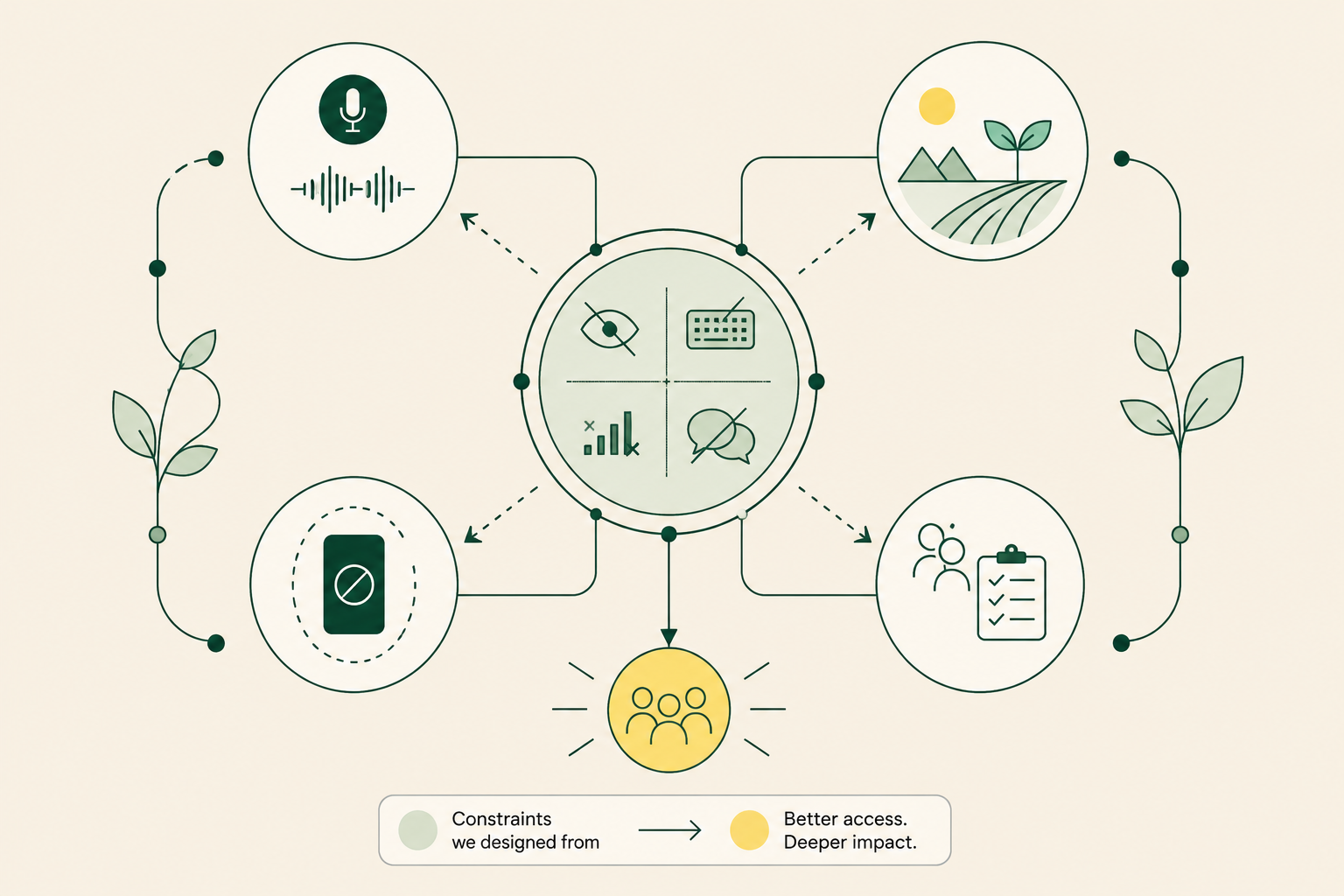
Radial diagram: four constraints — can't read, can't type, low bandwidth, no shared language — pointing inward toward better access and deeper impact
Constraints didn't limit the design. They shaped it. Every barrier (can't read, can't type, low bandwidth, no shared language) became a design directive that produced a better, more accessible product.
The most useful thing I learned at Digital Green is that designing for someone who does not share your language, your device, your literacy, your bandwidth, or your assumptions about technology is the actual job, and that most product design rounds in interviews don't ask about it.

This is the project I think about most often. It taught me to design from inside the user's world, not from inside the team's. It also taught me to take AI seriously, and skeptically. Generative models lower the cost of advice; they don't lower the cost of distribution, trust, or fit. That is still design's job.

Team: Cross-functional team of researchers, engineers, content designers, agricultural domain experts, and extension partners across India and East Africa.
My ownership: Research lead on voice and identity work; end-to-end UX for Farmer.Chat; prototype + testing on Vistaar; content-experience design on E-farm.

Next case study

Grab & Go: reimagining self-checkout